
The peer review process
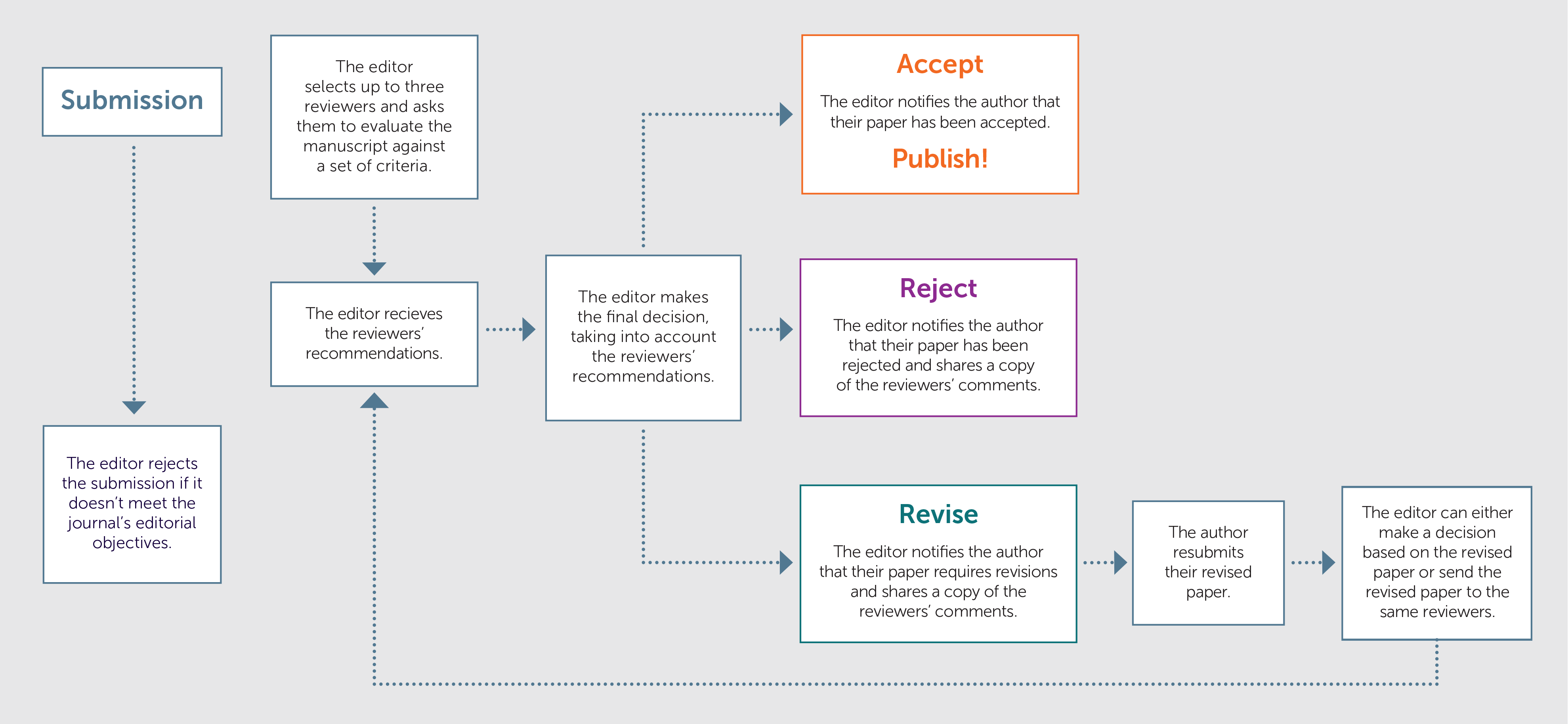
Submission
- The editor rejects the submission if it doesn’t meet the journal’s editorial objectives.
- The editor selects up to three reviewers and asks them to evaluate the manuscript against a set of criteria.
- The editor receives the reviewers’ recommendations.
- The editor makes the final decision, taking into account the reviewers’ recommendations. Go to 5 if accepted, 6 if rejected, or 7 if revisions are required.
Accept
- The editor notifies the author that their paper has been accepted > Publish
Reject
- The editor notifies the author that their paper has been rejected and shares a copy of the reviewers’ comments > Reject
Revise
- The editor notifies the author that their paper requires revisions and shares a copy of the reviewers’ comments.
- The author resubmits their revised paper.
- The editor can either make a decision based on the revised paper or send the revised paper to the same reviewers. Go to 3.
Peer review models
Double-anonymous peer review
In our peer review process, the identity of the author remains undisclosed to the reviewers, and similarly, the identities of the reviewers are kept confidential from the author. Beyond the framework of the triple-anonymous review model, this model stands as the most reliable approach to guarantee impartiality throughout the evaluation process.
This structure emphasizes the merit of the manuscript's content as the primary criterion for assessment, effectively neutralizing the potential for reviewer bias. Such bias, whether it manifests in a positive or negative manner, and whether it is deliberate or inadvertent, is thus systematically mitigated.
Become a reviewer
Why review?
Whether this is your first time reviewing or you are a seasoned professional, we explain why you should say yes next time an editor asks you to review.
- Reviewing establishes you as an expert in your field of research – it’s a great way to enhance your academic or professional reputation.
- You get the opportunity to read cutting-edge research before it has even been published.
- Reviewing offers an ideal opportunity to exercise your critical thinking skills in a private arena.
- You can return the favour – you are very likely a published author which means others have found the time to review your papers, now you can repay the courtesy.
- Building a relationship with a journal editorial team increases your chances of being invited to join an Editorial Advisory or Review Board.
How to become a reviewer for the Global Educational Research Review (GERR)?
Should you wish to contribute as a reviewer for The Global Educational Research Review (GERR), we kindly invite you to express your interest via email at [idmyresearch@gmail.com]. Please include in your communication a concise overview of your academic and professional background, detailing your achievements and any prior experience in peer review. We eagerly anticipate engaging with prospective reviewers and are committed to further elevating the excellence and efficiency of GERR's review procedures.
Reviewer guidelines
Generative AI Policy for Peer Reviewers
As part of our commitment to academic integrity, ethical peer review, and the confidentiality of unpublished manuscripts, this journal enforces the following policy regarding the use of generative AI (GAI) and AI-assisted technologies by peer reviewers.
Confidentiality and Prohibited Use of Generative AI
Peer reviewers must treat all submitted manuscripts as strictly confidential. Reviewers are strictly prohibited from uploading, sharing, or inputting any portion of a manuscript—including its supplementary files (figures, tables, appendices, or author data)—into generative AI tools, whether commercial (e.g., ChatGPT, Gemini, Claude, Copilot) or open-source.
This prohibition protects:
- Author confidentiality
- Intellectual property rights
- Compliance with data protection regulations (e.g., GDPR, PDPA)
Using generative AI to analyze, summarize, critique, or draft feedback on an unpublished manuscript constitutes a breach of reviewer responsibility and violates this journal’s policy.
Permitted Use of AI for Language Enhancement (With Limitations)
Reviewers may use AI-based tools solely to enhance the language (e.g., grammar, clarity, tone) of their review reports. However:
- No content from the manuscript may be inputted or paraphrased into the AI tool.
- Reviewers remain fully responsible for the accuracy, fairness, depth, and originality of the review.
- AI use must never compromise confidentiality or introduce automated bias.
This aligns with guidance from COPE and major publishers that peer review must be conducted by humans using expert judgment.
Reviewer Accountability and Integrity
Peer review is a cornerstone of scholarly publishing. It requires critical thinking, subject expertise, and ethical discernment—capacities that current AI technologies cannot reliably replicate.
Accordingly:
- Reviews generated (rather than merely edited) by AI will be disqualified.
- Reviewers who violate this policy may be permanently removed from the journal’s reviewer pool.
- Generative AI must never substitute for scholarly assessment.
Raising Concerns About AI-Generated Content in Submissions
If a reviewer suspects that a submitted manuscript contains undisclosed or inappropriate use of generative AI, such as unacknowledged AI-generated text, this concern should be raised confidentially with the handling editor.
The editorial team will conduct an investigation based on:
- Internal editorial policy
- COPE guidelines on authorship and AI use
- Transparency, due process, and author consultation
Where appropriate, the journal may request clarification from the author or initiate a formal ethics review.
Responsible Use of AI by Editors and the Journal
This journal may use secure, in-house, or licensed AI technologies to support editorial workflows (e.g., plagiarism screening, reviewer matching, or metadata validation). These tools:
- Are deployed internally with robust privacy safeguards
- Do not transmit manuscript content to public or external AI systems
- Comply with responsible AI principles and data protection laws
Editors and journal staff do not use generative AI to draft decision letters or summarize the content of unpublished manuscripts.
Before you review
You will receive an email inviting you to review for a journal, case study or book proposal with the option to accept or decline.
Here are some things to think about before you make your decision.
Time
Journal editors are looking for reviews that are thorough and specific. If you are unsure whether you have the capacity to deliver that level of quality, you can always recommend a colleague who has more free time. If you might like to review for the journal when you are less busy, don’t forget to let the editor know.
Best match
The editor may not be familiar with the finer details of your work, so you are best placed to judge whether you have the expertise required. To help the editor match you with the right paper, please keep your ScholarOne accounts up to date with relevant keywords and institutional details.
Deadlines
If an editor asks you to carry out a review, it’s a good idea to respond confirming you’ve received their request, even if you are unsure yet whether you will accept. The period of time allocated for the review will vary per journal and the editor will inform you of the time-frame when they invite you.
Conflicts of interest
Fully disclose any potential conflict of interest; it won’t necessarily eliminate you but will help the editorial team make an informed decision, for example:
- Working in the same department/institute as an author
- Having co-written with an author in the past
- Professional or financial connections to the research
Respond to your review request
You can accept or decline your review request from your invite email. For journals and case studies, the manuscript or case will be sent to your reviewer centre on our editorial system, which you can access directly from your email.
Review the manuscript
You will be asked detailed questions to encourage you to consider all aspects of the manuscript. For journals and case studies, you will complete the fields on the Review and Score tab in the reviewer centre on ScholarOne. Although the questions may vary depending on the journal or publication, we have highlighted some areas for consideration.
Ethics
As a reviewer, you are not responsible for spotting ethics issues in manuscripts but with your knowledge and expertise, you are often best placed to spot cases of fraud, plagiarism or possible defamation/libel. If you have reason to suspect ethical misconduct – either deliberate or accidental – please let the publisher or the editor know as soon as possible. You can find out more about the types of publishing issues you might encounter on our research and publication ethics guidelines page.
Originality
Does the article say something new and interesting? Does it add to the body of knowledge? Is the research question an important one? How does the manuscript compare to the most highly-cited or downloaded papers in the field? Tools such as Web of Science or Scopus can help answer these questions. If the research has been covered previously, forward any relevant references to the editor.
Layout and format
Each journal’s author guidelines contain instructions on manuscript presentation and authors are expected to follow these closely. If they don’t, and the editor hasn’t mentioned the omission in their invitation to review, you should flag the issue with the editor or highlight it in your review report. If the paper is particularly original or interesting, the editor may wait until they have decided to accept it before asking the author to reformat.
Title
Does it clearly describe the article and include the most important keywords? (Consider how you search for research articles.) Does it demonstrate the significance of the research and make sense?
Structured abstract
Have all mandatory fields been completed? Does the abstract accurately reflect the content of the article?
Introduction
Does this describe what the author hoped to achieve and clearly articulate the research question? Has the author provided a summary of the current research literature to provide context? Is it clear how this is being challenged or built upon? Are there any important works that have been omitted?
Methodology
Does the author accurately explain how the data was collected? Is the design suitable for answering the question posed? Does the article outline the procedures followed? If the methods are new, are they explained in detail? Is there sufficient information available for you to replicate the research? Was the sampling appropriate? Have the equipment and materials been adequately described? Does the article make it clear what type of data was recorded; has the author been precise in describing measurements?
Statistics
These should be checked carefully – errors are common.
Results
This is where the author should explain their findings. Are results presented clearly? You should consider the merits and appropriateness of the author’s analysis.
Conclusion/discussion
Are the claims in this section reasonable and supported by the results? Are the findings consistent with the author’s expectations? Do the conclusions adequately tie together the other elements of the paper? Does the article support or contradict previous theories? Does the author explain how the research has added to the body of knowledge?
Graphics and tables
Where these are included, please check the contents and, if possible, make suggestions for improvements. Do the figures and tables inform the reader? Are they an important part of the story? Do the figures describe the data accurately? Are they presented consistently (e.g. in the same format throughout)?
Language
Does poor use of English make it difficult to follow the author’s argument? If this is the case, it’s not up to you to edit the text. Mention the problem in your review report and the editor may decide to refer the author to editing services, for example, Editage, a company we partner with.
Implications for research
Does the paper bridge the gap between theory and practice? How can the research be applied;
- In practice: What's the economic and commercial impact?
- In teaching?
- To influence public policy?
- In research: Does it contribute to the body of knowledge?
- For society: Is it influencing public attitudes or affecting quality of life?
Are these implications consistent with the findings and conclusions of the paper?
Quality of communication
Does the paper clearly express its case, measured against the technical language of the field and the expected knowledge of the journal’s readership? Has attention been paid to the clarity of expression and readability, such as sentence structure, jargon use, acronyms and so on?
Make your recommendation
You will make an overall recommendation to the editor or publisher to complete your review and they will take this into account when they make their decision. The most common recommendation criteria are:
- Accept
- Minor revisions required
- Major revisions required
- Reject
Revisions
Minor revisions
This varies from journal to journal. However, minor revisions often require the author to make relatively small adjustments to the paper, which don’t take much time. They might be related to author guideline requirements, e.g. a slight reduction in word count; formatting changes, such as the labelling of tables or figures; further evidence of an understanding of the research literature in the field; or a slight elaboration on the research findings.
Major revisions
Major revisions often require the author to make more significant improvements, the type which take weeks or even months, rather than days. Authors may be asked to address flaws in the methodology; collect more data; conduct a more thorough analysis; or even adjust the research question to ensure the paper contributes something truly original to the body of work.
On this page
- The peer review process
- Submission
- Accept
- Reject
- Revise
- Peer review models
- Double-anonymous peer review
- Become a reviewer
- Why review?
- How to become a reviewer for the Global Educational Research Review (GERR)
- Reviewer guidelines
- Generative AI Policy for Peer Reviewers
- Confidentiality and Prohibited Use of Generative AI
- Permitted Use of AI for Language Enhancement (With Limitations)
- Reviewer Accountability and Integrity
- Raising Concerns About AI-Generated Content in Submissions
- Responsible Use of AI by Editors and the Journal
- Before you review
- Time
- Best match
- Deadlines
- Conflicts of interest
- Respond to your review request
- Review the manuscript
- Ethics
- Originality
- Layout and format
- Title
- Structured abstract
- Introduction
- Methodology
- Results
- Conclusion/discussion
- Graphics and tables
- Language
- Implications for research
- Quality of communication
- Make your recommendation
- Revisions
- Minor revisions
- Major revisions